Quick Summary & Key Takeaways
- Best for visual concept mapping: Heptabase ($11.99/mo) turns dense PDF libraries into interactive whiteboard cards, mind maps, and interconnected research canvases.
- Best for 100% private offline notes: Obsidian with Smart Connections (Free, Open Source) embeds your Markdown vault locally with zero cloud telemetry and BYOK model routing.
- Best for editable audio overviews: Wondercraft AI ($34/mo) transforms source documents into multi-host podcasts with full script editing, custom voices, and zero hallucinated drift.
Free Interactive Companion Tool
Test inputs and calculate figures directly with our in-browser tool
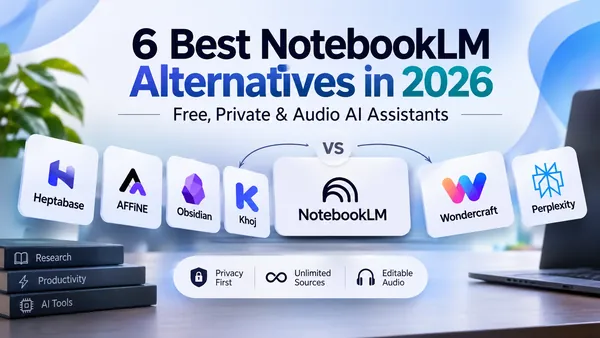
6 Best NotebookLM Alternatives in 2026 (Free, Private & Audio AI Assistants)
Google NotebookLM changed document research by grounding language models directly against user-uploaded notes and turning dense study materials into conversational two-host Audio Overviews. For millions of students and knowledge workers, it provided an effortless entry point into AI-assisted research.
However, strict 50-source boundaries, uneditable podcast transcripts, closed Google Cloud data ingestion, and the absence of visual knowledge mapping push serious researchers toward dedicated alternatives. Whether you need a local-first private vault, an infinite spatial whiteboard, or full studio control over audio summaries, this guide compares the six leading notebooklm alternatives across real research workflows, privacy safeguards, and token economics.
Upfront Comparison: 6 Best NotebookLM Alternatives at a Glance
The table below outlines how leading alternatives to notebooklm compare against Google NotebookLM across storage architecture, frontier model access, source limits, and verified late 2026 pricing.
| Tool Name | Best For | Storage Architecture | Frontier Models Supported | Source Ingestion Limits | Pricing (Nov 2026) |
|---|---|---|---|---|---|
| Heptabase | Visual whiteboard synthesis | Cloud sync with local SQLite cache | Claude 5.5 Sonnet, GPT-6 | Unlimited PDFs, videos, and web notes | $11.99 / mo ($9.99 / mo billed annually) |
| AFFiNE | Open-source multimodal workspace | Local-first CRDT + self-hosted Docker | Claude 5.5 Sonnet, DeepSeek V3, Ollama | Unlimited local docs, blocks, and PDFs | Free open source; Pro at $9.99 / mo |
| Obsidian + Smart Connections | Zero-telemetry private vault | 100% local Markdown directory | Any model via BYOK (OpenRouter, Ollama) | Unlimited local Markdown and PDF files | Free open source; pay raw API tokens |
| Khoj | Self-hosted AI second brain | Local Docker container or cloud | DeepSeek R1/V4, Claude 5.5 Sonnet, Ollama | Unlimited files, Notion sync, GitHub repos | Free self-hosted; Cloud Pro at $10 / mo |
| Wondercraft AI | Studio-grade editable audio overviews | Managed cloud audio workstation | GPT-6, Claude 5.5 Sonnet, ElevenLabs | Upload full PDFs, URLs, and scripts | Starter from $34 / mo ($29 / mo annual) |
| Perplexity Pro Spaces | Live web synthesis + document archives | Managed cloud search index | Claude 5.5 Sonnet, OpenAI GPT-6, Grok | Up to 50+ files per Space + live web search | Free basic tier; Pro at $20 / mo |
Why Researchers Look for NotebookLM Alternatives in 2026
While Google NotebookLM remains popular for quick reference lookups, academic scholars, corporate intelligence teams, and long-term knowledge managers frequently encounter four critical operational bottlenecks:
- The 50-Source Hard Ceiling and Notebook Siloing: NotebookLM caps every notebook at 50 sources, with each source limited to 500,000 words. When conducting literature reviews or cross-disciplinary research spanning hundreds of papers, users must split documents across multiple notebooks. Because NotebookLM cannot run federated queries across notebooks, cross-referencing insights between disparate projects becomes impossible.
- Uneditable Audio Overviews and Audio Drift: The viral Audio Overview feature generates compelling podcast discussions, but users cannot edit the generated dialogue, adjust speaker pacing, fix mispronounced technical terms, or swap voice profiles. If the audio hosts misinterpret an equation or hallucinate a claim, you must regenerate the entire 12-minute clip and hope for a cleaner take.
- Cloud Telemetry and Enterprise Data Governance: NotebookLM stores all uploaded files and query histories in Google Cloud. For healthcare analysts handling HIPAA-restricted health records, legal teams reviewing non-disclosure agreements, or proprietary enterprise engineers, uploading unpublished intellectual property to public cloud endpoints introduces regulatory friction.
- Lack of Visual and Spatial Synthesis: NotebookLM relies on a traditional linear chat sidebar. Complex mental models require visual thinking - grouping ideas on infinite whiteboards, linking concepts through bidirectional graphs, and highlighting PDF passages side-by-side with working drafts.
1. Heptabase: Best for Visual Whiteboard Research and Concept Mapping
Heptabase is designed for researchers who find conversational chat windows too limiting for complex structural reasoning. Built around an infinite spatial canvas, Heptabase combines PDF annotation, card-based Zettelkasten note-taking, and visual mind mapping into a cohesive knowledge workspace.
Instead of asking a chat assistant to summarize documents in a sidebar, you open source PDFs directly alongside an interactive whiteboard. You can highlight text passages, drag excerpts out of the PDF to create visual cards, and connect those cards with labeled relationship lines across topic boards. An integrated AI assistant routes through Claude 5.5 Sonnet and GPT-6 to help cluster connected concepts, extract comparative themes, and draft synthesis notes without detaching you from your visual workspace.
Key Capabilities
- Advantage: Drag-and-drop PDF extraction lets you turn highlighted source quotes into visual whiteboard cards with live bidirectional links.
- The Real Catch: Closed-source architecture with no permanent free tier; requires a paid subscription following a 7-day trial.
- Best For: Academics, non-fiction authors, and systems researchers working through complex literature reviews that demand spatial layout.
- Verified Pricing: $11.99 per month billed monthly, or $119.88 per year ($9.99 per month equivalent).
| Evaluation Metric | Heptabase | Google NotebookLM (Baseline) |
|---|---|---|
| Workspace Interface | Spatial whiteboard canvas + card database | Linear chat sidebar + source index list |
| Source Ingestion Limits | Unlimited PDFs, web articles, images, and notes | Maximum 50 sources per notebook |
| Visual Concept Mapping | Native mind maps, nested whiteboards, and arrows | None (text chat and note cards only) |
| Audio Generation | None (focuses purely on visual and text synthesis) | Automated two-host Audio Overview podcasts |
| Data Ownership | Local-first SQLite database with cloud backup | Hosted entirely on Google Cloud infrastructure |
Pricing & Plans (Verified Nov 2026)
- 7-Day Free Trial: Full access to all desktop applications, infinite whiteboard canvases, and PDF annotation tools.
- Monthly Subscription: $11.99/mo, billed every 30 days. Includes multi-device synchronization, integrated AI synthesis queries, and unlimited visual whiteboards.
- Annual Subscription: $9.99/mo ($119.88 billed annually), saves 17% and includes priority feature updates and expanded cloud backup storage.
2. AFFiNE: Best Open-Source Multimodal Workspace with Local-First Canvas
AFFiNE is an open-source, local-first knowledge base that merges document writing, whiteboard ideation, and AI copilot interactions into a single application. Often described as an open-source hybrid of Notion, Miro, and NotebookLM, AFFiNE operates without forcing you to choose between linear documents and freeform drawing canvases.
Every page in AFFiNE switches instantly between Doc Mode for clean Markdown writing and Edgeless Canvas Mode for spatial brainstorming. The integrated AFFiNE AI copilot indexes your local files to answer research queries, summarize uploaded slide decks, convert raw notes into structured tables, and draw mind maps directly onto your canvas. Because the core engine is built on open standards and conflict-free replicated data types (CRDTs), your data remains accessible offline and can be self-hosted on private hardware via Docker.
Key Capabilities
- Advantage: True local-first architecture keeps all database blocks on your device while allowing instant switching between structured text and infinite visual canvas.
- The Real Catch: Advanced cloud collaboration and hosted multi-modal AI credits require an active cloud plan or self-configured API keys.
- Best For: Privacy-focused researchers, developers, and product teams looking for a completely free open-source workspace with native AI assistance.
- Verified Pricing: Free open source (self-hosted); Cloud Pro tier at $9.99 per month ($7.99 per month billed annually).
| Evaluation Metric | AFFiNE | Google NotebookLM (Baseline) |
|---|---|---|
| License & Open Source | Open source (AGPLv3) with public GitHub repo | Closed proprietary Google product |
| Dual-Mode Workspace | Instant toggle between structured document and canvas | Fixed document viewer with side panel |
| Offline Functionality | 100% functional offline via local SQLite/CRDT engine | Requires constant active internet connection |
| Model Flexibility | Cloud frontier models or self-hosted local LLMs | Restricted to Google Gemini internal models |
| Audio Overviews | Not supported natively | Native two-host conversational audio generation |
Pricing & Plans (Verified Nov 2026)
- Community Edition: 100% Free and open source. Unlimited local blocks, docs, whiteboards, and offline storage.
- AFFiNE Cloud Pro: $9.99/mo ($7.99/mo billed annually), includes 100GB cloud storage, cross-device synchronization, and monthly AI generation credits for multimodal assistance.
- Self-Hosted Enterprise: Custom licensing for teams requiring dedicated Docker deployment, custom SSO, and air-gapped security policies.
3. Obsidian + Smart Connections: Best 100% Private Markdown Knowledge Graph
Obsidian paired with the open-source Smart Connections plugin represents the gold standard for private, future-proof AI document research. Obsidian stores your entire knowledge base as a local folder of standard plain-text Markdown files on your own hard drive, completely independent of proprietary cloud services.
The Smart Connections plugin transforms this plain-text archive into an intelligent, vector-indexed second brain. It generates local embeddings using the BGE model family or connects to your personal API keys for Anthropic, OpenAI, or OpenRouter. You can query your entire vault of thousands of research notes, academic papers, and meeting records simultaneously. When configuring local LLMs through our guide to Ollama vs LM Studio, you can run vector search and response generation entirely on local hardware with zero external network requests.
Key Capabilities
- Advantage: 100% local data privacy with zero source count limits; indexes tens of thousands of notes and PDFs across your hard drive.
- The Real Catch: Requires manual plugin installation, API key configuration, and basic knowledge of Markdown folder organization.
- Best For: Security engineers, academic researchers, and technical writers who refuse to surrender data ownership to proprietary cloud platforms.
- Verified Pricing: Obsidian is 100% free for personal use; Smart Connections is free open-source software (pay raw API tokens or $0 with local Ollama).
| Evaluation Metric | Obsidian + Smart Connections | Google NotebookLM (Baseline) |
|---|---|---|
| File Storage Format | Local plain-text Markdown files (.md) on disk | Proprietary cloud document database |
| Document Ingestion Limits | Unlimited (scales to 50,000+ files and full vaults) | 50 sources per individual notebook |
| Source Citation Method | Exact block references and wikilinks to local notes | Document-level excerpts in chat sidebar |
| Privacy & Air-Gap | Fully air-gapped with local Ollama models | All data indexed on Google cloud servers |
| Setup Complexity | Moderate (requires configuring community plugins) | Zero setup (sign in with Google account) |
Pricing & Plans (Verified Nov 2026)
- Obsidian Core: 100% Free for personal and academic use with unlimited local files, graph view, and community plugin access.
- Smart Connections Plugin: Free open-source software under GitHub community maintenance.
- Obsidian Sync (Optional): $5/mo ($4/mo billed annually) for end-to-end encrypted device synchronization, or use free git repositories.
- API Model Costs: Raw token pricing from your provider. Running a personal API key on Claude 5.5 Sonnet or OpenAI typically costs between $1 and $5 per month for active researchers. Review our guide on how to calculate LLM token costs to track your embedding expenses.
4. Khoj: Best Self-Hosted AI Second Brain for Desktop and Docker
Khoj is an open-source personal AI research assistant that builds an indexed knowledge base across your notes, PDFs, Notion pages, and GitHub repositories. Available as a desktop application, a web interface, and a self-hosted Docker container, Khoj is designed for users who want the conversational synthesis of NotebookLM without corporate data lock-in.
Khoj connects directly to your digital life across multiple applications. Once pointed at your research folders, it runs background incremental indexing to keep document embeddings updated. You can ask Khoj complex factual questions, request cross-document synthesis, and configure automated agents that trigger recurring research summaries. It supports both cloud frontier models like Claude 5.5 Sonnet and DeepSeek R1, as well as local Ollama instances, ensuring your queries respect your privacy boundaries.
Key Capabilities
- Advantage: Multi-source integration indexes local PDFs, Markdown notes, GitHub code, and Notion workspaces into a unified research brain.
- The Real Catch: Self-hosting the Docker container requires basic command-line familiarity and hardware resources for vector indexing.
- Best For: Developers, technical teams, and self-hosting enthusiasts who want an open-source personal copilot across multiple productivity apps.
- Verified Pricing: Free open source (self-hosted); Cloud Starter is free; Cloud Pro costs $10 per month ($8 per month billed annually).
| Evaluation Metric | Khoj | Google NotebookLM (Baseline) |
|---|---|---|
| Deployment Options | Desktop app, Docker container, or managed cloud | Web browser client only |
| Cross-Platform Connectors | Local folders, Notion, GitHub, Org-mode, PDFs | Google Drive, text paste, PDFs, YouTube |
| Agent Automations | Scheduled research tasks and recurring summaries | Manual conversational queries only |
| Search Methodology | Hybrid dense-sparse retrieval + vector reranking | Proprietary Google semantic embeddings |
| Native Voice Audio | Voice input and text-to-speech output | Two-host conversational podcast generation |
Pricing & Plans (Verified Nov 2026)
- Self-Hosted Community: 100% Free. Deploy via Docker with your own local models or personal API keys.
- Cloud Free Tier: $0/mo, includes 30 search queries per month and basic file uploads hosted on Khoj cloud servers.
- Cloud Pro Plan: $10/mo ($8/mo billed annually), includes unlimited queries, frontier model routing (Claude 5.5 Sonnet, GPT-6), 10GB document storage, and automated recurring research agents.
5. Wondercraft AI: Best Studio-Grade Editable Audio Overview Generation
Wondercraft AI is the primary alternative for users whose favorite NotebookLM feature is Audio Overviews, but who need real editorial control over the finished product. While NotebookLM produces an impressive audio discussion, it acts as a black box: you cannot edit the transcript, choose your voice talent, or fix incorrect factual statements.
Wondercraft solves this limitation by operating as an AI-powered creative audio workstation. You upload your research papers, whitepapers, or book chapters, and Wondercraft's language engine generates an initial two-host podcast script. Crucially, you have complete control to edit the transcript line-by-line, swap out host voices using hyper-realistic ElevenLabs speech models, add background music beds, and regenerate specific sentences that contain errors. For educators, corporate communication teams, and content creators, it turns research materials into professional, broadcast-ready audio.
Key Capabilities
- Advantage: Complete line-by-line transcript editing, custom voice selection, and multi-track audio mastering for generated research podcasts.
- The Real Catch: Significantly higher price point than note-taking tools; designed for media production rather than long-term knowledge storage.
- Best For: Educators, marketing teams, corporate trainers, and podcasters who want to turn complex research into publication-ready audio.
- Verified Pricing: Starter tier from $34 per month ($29 per month billed annually); Creator tier at $89 per month.
| Evaluation Metric | Wondercraft AI | Google NotebookLM Audio Overviews |
|---|---|---|
| Script & Transcript Editing | Full line-by-line text editing before rendering | Completely uneditable black-box output |
| Voice Customization | 100+ professional voices, accents, and voice clones | Two fixed, unchangeable host voices |
| Audio Segment Regeneration | Regenerate individual sentences or paragraphs | Must re-render the entire episode from scratch |
| Music & Pacing Control | Multi-track timeline with intros, music, and pauses | Fixed automated audio track |
| Primary Output Focus | Broadcast-ready podcasts, audiobooks, and briefings | Casual personal study summaries |
Pricing & Plans (Verified Nov 2026)
- Free Trial: Includes 5 minutes of generated audio to test script generation and studio voice models.
- Starter Plan: $34/mo ($29/mo billed annually), provides 60 minutes of audio generation per month, full script editor access, and commercial audio licenses.
- Creator Plan: $89/mo ($74/mo billed annually), expands capacity to 180 minutes of audio per month, multi-host conversations, custom voice cloning, and translation into 30+ languages.
- Enterprise Plan: Custom volume pricing with team collaboration, dedicated account management, and enterprise compliance agreements.
6. Perplexity Pro Spaces: Best for Live Web Grounding and Multi-Model Research
Perplexity Pro Spaces bridges the gap between static document analysis and real-time internet intelligence. While NotebookLM confines its analysis strictly to the 50 files you manually upload, Perplexity Spaces lets you combine uploaded research archives with live web search.
Inside a Perplexity Space, you can upload up to 50 documents (including PDFs, CSV spreadsheets, and code files) while configuring custom instructions for the research agent. When you submit a prompt, Perplexity queries both your uploaded documents and live web citations simultaneously. It also gives you model flexibility: you can switch between Claude 5.5 Sonnet, OpenAI GPT-6, and reasoning models like DeepSeek R1 depending on whether your prompt requires deep mathematical deduction or nuanced textual synthesis. This multi-model approach makes it easy to compare findings against benchmarks detailed in our Claude Opus 5.5 vs Gemini Argon 4 Pro analysis.
Key Capabilities
- Advantage: Combines uploaded research documents with real-time web search and instant switching between top frontier reasoning models.
- The Real Catch: Document uploads remain stored in Perplexity cloud servers; not suitable for air-gapped, zero-telemetry enterprise workflows.
- Best For: Financial analysts, market researchers, and journalists who need to cross-examine uploaded internal reports against live industry news.
- Verified Pricing: Free basic search; Pro subscription at $20 per month ($200 per year billed annually).
| Evaluation Metric | Perplexity Pro Spaces | Google NotebookLM (Baseline) |
|---|---|---|
| Live Internet Access | Real-time web citations combined with uploaded files | Static analysis restricted only to uploaded files |
| Model Selection | Claude 5.5 Sonnet, GPT-6, DeepSeek R1, Grok | Gemini internal model family only |
| File Upload Support | PDFs, CSVs, Word documents, code files | PDFs, Google Docs, Slides, URLs, audio |
| Output Capabilities | In-depth research reports, charts, and Perplexity Pages | Chat responses, study guides, and Audio Overviews |
| Collaborative Spaces | Shared team spaces with member access controls | Shareable view-only or editor links |
Pricing & Plans (Verified Nov 2026)
- Free Tier: Unlimited quick searches with basic web grounding and limited daily file uploads.
- Perplexity Pro: $20/mo ($200/year billed annually), includes 300+ daily Pro queries, unlimited document uploads to Spaces, file analysis across Claude 5.5 Sonnet and GPT-6, and API credits.
- Enterprise Pro: $40/user/mo ($400/user/year billed annually), adds SOC2 Type II compliance, single sign-on (SSO), administrative controls, and zero data retention guarantees for corporate security.
12-Month Total Cost of Ownership (TCO) Across Research Scenarios
Evaluating the actual expense of an AI research assistant requires looking beyond headline monthly fees. Free open-source tools require self-hosted hardware compute or pay-as-you-go API keys, while managed applications charge recurring per-seat subscriptions.
The table below calculates the estimated 12-month total cost of ownership across three common practitioner scenarios based on published late 2026 rates.
| Tool / Setup | Scenario 1: Solo Academic (1 Seat) | Scenario 2: Content Team (3 Seats) | Scenario 3: Privacy Corporate (5 Seats) | Primary Cost Drivers |
|---|---|---|---|---|
| Google NotebookLM | $0 / year | $0 / year | Incompatible (Cloud data exposure) | Free consumer tool; zero custom API costs |
| Heptabase | $119.88 / year | $359.64 / year | Incompatible (Cloud sync only) | Flat annual subscription fee per seat |
| AFFiNE | $0 (Self-Hosted) or $95.88 / yr | $287.64 / year (Cloud Pro) | $0 (Self-Hosted Docker on internal servers) | Server infrastructure or cloud collaboration plan |
| Obsidian + Smart Connections | $24 to $48 / year (BYOK API) | $72 to $144 / year (BYOK API) | $0 / year (Local Ollama on secure workstations) | Raw LLM token usage or zero with local models |
| Khoj | $0 (Self-Hosted) or $96 / yr | $288 / year (Cloud Pro) | $0 (Self-Hosted Docker behind firewall) | Local hardware compute or managed cloud tier |
| Wondercraft AI | $348 / year (Starter tier) | $1,044 / year | $2,400+ / year (Enterprise custom plan) | Monthly audio minutes and studio voice synthesis |
| Perplexity Pro | $200 / year | $600 / year (Standard Pro) | $2,400 / year (Enterprise Pro with zero retention) | Per-seat Pro subscription with multi-model access |
Scenario Breakdown & Cost Realities
- Solo Graduate Student or Independent Scholar: If you need visual mind mapping, Heptabase at $119.88 per year provides immense structural clarity for thesis drafting. For students on a strict zero-dollar budget, Obsidian paired with Smart Connections and a pay-as-you-go OpenRouter key provides enterprise-grade document search for under $3 per month in actual token usage.
- Technical Content or Research Team (3 Seats): For teams producing whitepapers, podcasts, and documentation, pairing Perplexity Pro ($600/year total) for web research with Wondercraft AI ($1,044/year) for editable audio overviews delivers an end-to-end media production engine that NotebookLM cannot match.
- Privacy-First Corporate Intelligence (5 Seats): For compliance-bound organizations, consumer tools like NotebookLM are strictly non-viable due to data leakage risks. Self-hosting AFFiNE or Khoj on an internal server via Docker, or deploying Obsidian with local Ollama models across company laptops, achieves 100% data privacy at zero recurring software licensing costs.
Decision Framework: Which NotebookLM Alternative Fits Your Research Workflow?
Choosing the right alternative to notebooklm depends on your primary research bottleneck: spatial concept mapping, unconstrained source indexing, offline data ownership, or editable audio production. Use this structured decision matrix to guide your selection:
| Research Priority / Primary Need | Recommended Tool | 2026 Pricing Floor | Deciding Architectural Factor |
|---|---|---|---|
| Visual Mind Mapping & PDF Extraction | Heptabase | $9.99 / mo (annual) | Drag-and-drop PDF passages directly onto whiteboard canvases |
| Open-Source Multimodal Workspace | AFFiNE | $0 (Free Open Source) | Local-first CRDT database with instant doc-to-canvas mode switching |
| 100% Offline Vault & Zero Telemetry | Obsidian + Smart Connections | $0 / Free (BYOK) | Plain Markdown files stored locally with private vector embeddings |
| Multi-App Second Brain (Notion, GitHub, PDF) | Khoj | $0 (Self-Hosted) or $8 / mo | Automated research agents indexing desktop and cloud work streams |
| Professional Editable Audio Overviews | Wondercraft AI | $29 / mo (annual) | Line-by-line script editor, custom voice casting, and audio mastering |
| Live Web Synthesis + Document Archives | Perplexity Pro Spaces | $20 / mo (or $200 / yr) | Simultaneous indexing of uploaded files and real-time web citations |
Recommendation by Practitioner Persona
- The Visual Academic and Book Author: Choose Heptabase. Its ability to extract PDF highlights onto a spatial canvas lets you spot hidden thematic connections across hundreds of sources that traditional chat boxes obscure.
- The Open-Source Minimalist and Privacy Purist: Choose Obsidian with Smart Connections. You retain absolute ownership over your Markdown files, bypass cloud telemetry entirely, and connect directly to local models or raw API endpoints.
- The Media Producer and Corporate Educator: Choose Wondercraft AI. It delivers the conversational audio overview format that made NotebookLM famous, but gives you the editorial tools required to eliminate factual errors and cast professional voice talent.
- The Real-Time Market and Financial Analyst: Choose Perplexity Pro Spaces. By blending uploaded corporate filings with live web search and frontier reasoning models, it ensures your research never relies on outdated knowledge cutoffs.
Before executing high-volume document embedding pipelines or automated agent workflows, estimate your projected token consumption and API expenditures with our client-side AI token calculator.