
Quick Summary & Key Takeaways
- Lovable popularized prompt-driven fullstack development by combining React frontends with automated Supabase schemas and two-way GitHub synchronisation.
- Developers migrate away from Lovable when hitting strict Vite and React framework constraints, monthly message quotas, or the need for multi-language microservices.
- Bolt.new, v0, Replit Agent, Cursor, Windsurf, Emergent, and Marblism each solve distinct architectural bottlenecks ranging from browser sandboxes to enterprise test pipelines.
Free Interactive Companion Tool
Test inputs and calculate figures directly with our in-browser tool
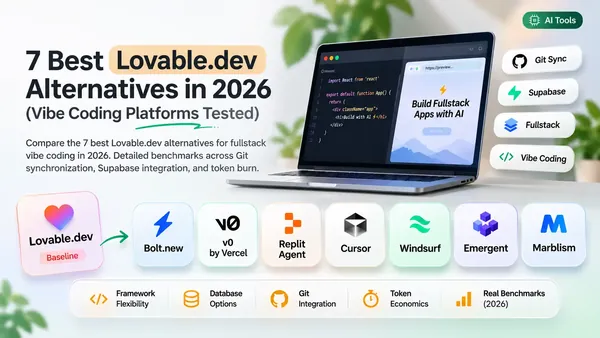
7 Best Lovable.dev Alternatives in 2026 (Vibe Coding Platforms Tested)
Prompt-driven application generators allow founders, designers, and engineers to ship production-ready web apps from conversational English in hours. At the center of this movement is Lovable, which pairs real-time visual browser previews with automated Supabase PostgreSQL provisioning and bidirectional GitHub synchronization.
However, engineering teams frequently hit limits when projects demand Next.js server components, Python microservices, or custom backends. If you need dependable lovable alternatives, this guide benchmarks seven leading platforms across code quality, Git sync, and real token burn.
Upfront Comparison: 7 Best Lovable Alternatives (Verified 2026)
The matrix below benchmarks Lovable against the seven top alternatives across runtime environment, supported frameworks, database integrations, version control, and entry pricing:
| Tool | Primary Best For | Runtime Sandbox | Default Frontier Models | Database Support | Version Control | Starting Price (Late 2026) |
|---|---|---|---|---|---|---|
| Lovable.dev (Baseline) | Production React & Supabase apps | Cloud preview container | Claude Sonnet 5.5, GPT-6 | Native Supabase PostgreSQL | Two-way GitHub sync | Free (5 msgs/day) / $20/mo |
| Bolt.new | Browser WebContainer execution | Client-side WebAssembly | Claude Sonnet 5.5, Gemini Argon 4 | Local SQLite, REST APIs | Git export & PR push | Free tier / $20/mo (Pro) |
| v0 by Vercel | Component-level UI prototyping | Vercel Serverless preview | Claude Sonnet 5.5, GPT-6 | Vercel Postgres, KV, Supabase | GitHub integration & CLI | Free (200 credits) / $20/mo |
| Replit Agent | Full autonomous deployment | Cloud Linux VM (Nix container) | Claude Sonnet 5.5, GPT-6 | Native PostgreSQL & SQLite | Full Git version history | $20/mo (Replit Core) + compute |
| Cursor | Professional local IDE workflows | Local host OS & Docker | Claude Sonnet 5.5, GPT-6, o3 | Any local or cloud database | Native Git worktrees | Free tier / $20/mo (Pro) |
| Windsurf by Codeium | Cascade flows & multi-file reasoning | Local host OS & terminal | Claude Sonnet 5.5, Gemini Argon 4 Pro | Any local or cloud database | Native Git versioning | Free tier / $15/mo (Pro) |
| Emergent | Enterprise apps with test suites | Isolated cloud staging container | Claude Sonnet 5.5, GPT-6 | Managed PostgreSQL & Redis | Automated PR workflow | Free starter / $30/mo (Team) |
| Marblism | Production SaaS boilerplate & Stripe | Cloud generation container | GPT-6, Claude Sonnet 5.5 | Prisma ORM, Supabase, Neon | Full GitHub repository export | $29/mo (Starter) |
Why Developers Search for Lovable Alternatives in 2026
While Lovable remains popular for quick prototyping, building long-term software reveals four common architectural constraints:
- Strict Framework Lock-In: Lovable builds exclusively within Vite, React, and TypeScript. Developers wanting Vue, SvelteKit, Astro, Next.js App Router, or native mobile clients like React Native cannot use the platform without manual rewrites.
- Backend Runtime Restrictions: Lovable relies on Supabase edge functions and client-side database calls. Applications requiring heavy background workers, Python machine learning pipelines, WebSockets, or custom Redis queues require external infrastructure.
- Monthly Message Allocation Exhaustion: Lovable uses fixed monthly prompt credits. When an AI agent introduces a subtle state bug or styling regression, ten consecutive correction prompts can consume a significant share of your monthly tier.
- Component-Level Context Drift: As projects exceed fifty source files, browser-based web builders often struggle to retain complete architectural context, sometimes modifying unrelated UI components during minor feature additions.
Practitioners transitioning away from browser-only generators frequently consult our ranking of vibe coding agents to see how agent architectures compare across broader engineering workflows.
The Claude Tokenizer Reality and Sandbox Token Economics
Frontier vibe coding platforms rely on Claude Sonnet 5.5 and Opus 5.5. Because Anthropic's BPE tokenizer encodes whitespace and syntax punctuation with 18% to 30% higher token volume than OpenAI's o200k_base, multi-turn editing accelerates token burn:
| Code File Type (1,000 Lines of Code) | OpenAI o200k_base Tokens |
Anthropic Claude BPE Tokens | Token Volume Variance |
|---|---|---|---|
| React TypeScript Component (Hooks + JSX) | ~5,900 tokens | ~7,550 tokens | +27.9% higher volume |
| Tailwind CSS Layout with Dense Classes | ~6,300 tokens | ~8,200 tokens | +30.1% higher volume |
| Database Migration Script (PostgreSQL SQL) | ~4,200 tokens | ~5,100 tokens | +21.4% higher volume |
| API Route Handler (REST / JSON Payloads) | ~4,800 tokens | ~5,950 tokens | +23.9% higher volume |
Without prompt caching discounts (such as Anthropic's 90% read reduction), multi-turn agent iterations exhaust quotas. You can calculate LLM token burn using our free utility before subscribing.
1. Bolt.new: Best for In-Browser Fullstack WebContainer Execution
StackBlitz built Bolt.new around WebContainers, an operating system environment compiled to WebAssembly that runs entirely inside your web browser. Unlike Lovable's preview container, Bolt.new executes a real Node.js environment directly in your browser tab.
Because WebContainers run client-side, Bolt.new can install npm dependencies, compile Vite builds, and run client-side development servers without spinning up remote cloud virtual machines.
Key Capabilities
Bolt.new lets you prompt, build, and run fullstack web applications with immediate terminal feedback. When the AI agent generates code, it executes shell commands inside the WebContainer, catches build errors in real time, and applies corrective patches autonomously.
The platform supports multiple frontend and fullstack frameworks, including Vite, Next.js, Remix, SvelteKit, and Astro. This flexibility makes Bolt.new significantly more framework-agnostic than Lovable.
Real Field Trade-Offs
- Advantage: Full terminal execution inside WebContainers allows the AI agent to install packages, run tests, and fix compile errors autonomously.
- The Real Catch: Client-side browser tabs have strict memory limits. Once an application exceeds 2GB of active memory, heavy Webpack or Vite reloads can cause browser tab crashes.
- Best For: Developers who want immediate fullstack prototyping across diverse frameworks without configuring local development environments.
- Verified Pricing: Free tier provides basic daily tokens; Pro plan costs $20/month for 10 million monthly tokens and priority model compute.
Pricing & Plans (Verified Late 2026)
| Plan Tier | Monthly Price | Included Tokens / Limits | Core Capabilities |
|---|---|---|---|
| Free | $0/mo | Limited daily tokens | Public WebContainer projects, standard models |
| Pro | $20/mo | 10M tokens/month | Private projects, Claude Sonnet 5.5, GitHub sync |
| Pro 50 | $50/mo | 26M tokens/month | Extended context windows, priority generation |
| Enterprise | Custom pricing | Dedicated token pools | Custom SSO, team permissions, SLA support |
For an in-depth breakdown of self-hosted and hosted alternatives to Bolt, read our hands-on Bolt.new alternatives analysis.
2. v0 by Vercel: Best for Component-Level Tailwind & React Frontend Prototyping
Vercel launched v0 by Vercel to solve generative UI engineering for modern React and Next.js applications. While Lovable attempts to build complete fullstack applications with databases in one prompt, v0 focuses on generating accessible UI components.
Trained extensively on React design systems, Tailwind CSS, and shadcn/ui primitives, v0 produces clean frontend markup that engineers can drop directly into enterprise codebases.
Key Capabilities
v0 excels at visual component iteration. You can prompt for a complex pricing calculator, customer dashboard sidebar, or data grid, and v0 generates modern, responsive code. The interface includes an interactive preview where you can toggle responsive viewport sizes and inspect individual DOM nodes.
Integration with the Vercel ecosystem is direct and fluid. With the npx v0 add command, you can export components directly into your local Next.js project directory via the terminal, complete with required Tailwind utility dependencies.
Real Field Trade-Offs
- Advantage: Generates high-quality React, Tailwind CSS, and shadcn/ui components with accessible semantic markup.
- The Real Catch: v0 is primarily a frontend design engine; it does not automatically provision full relational databases, server migrations, or authentication tables like Lovable.
- Best For: Frontend engineers and product designers who need production-ready React components to insert into existing web applications.
- Verified Pricing: Free tier includes 200 monthly credits; Premium costs $20/month for 5,000 monthly credits with priority generation.
Pricing & Plans (Verified Late 2026)
| Plan Tier | Monthly Price | Monthly Credits | Key Features |
|---|---|---|---|
| Free | $0/mo | 200 credits/mo | Public generations, standard processing |
| Premium | $20/mo | 5,000 credits/mo | Private projects, Claude Sonnet 5.5, priority queues |
| Team | $30/mo per seat | 7,500 credits/user | Shared component libraries, team billing |
| Enterprise | Custom pricing | Pooled credits | Custom model fine-tuning, security audit logs |
3. Replit Agent: Best for Autonomous Deployment with Persistent Cloud Backends
Replit approached vibe coding from an infrastructure-first perspective. Replit Agent operates inside a persistent Linux virtual machine running Nix environments, allowing it to execute virtually any programming language or system library.
While Lovable is constrained to browser-compatible JavaScript and Supabase, Replit Agent can scaffold Python Flask backends, FastAPI services, Node.js applications, and Go services with equal proficiency.
Key Capabilities
Replit Agent acts as an autonomous fullstack software engineer. When given an application prompt, it plans the database schema, installs system dependencies, configures environment variables, writes server routes, and boots a live development server.
Crucially, Replit provisions persistent PostgreSQL and SQLite databases natively within its cloud environment. When your application is ready, Replit handles custom domain mapping, SSL provisioning, and production hosting in a single click.
Real Field Trade-Offs
- Advantage: Full Linux virtual machine support allows deployment of Python, Node, Go, Docker, and background workers without frontend framework restrictions.
- The Real Catch: Autonomous agent runs can consume compute checkpoints rapidly, leading to supplemental infrastructure charges on complex multi-step builds.
- Best For: Founders and fullstack developers building data-intensive applications, web scrapers, and multi-language APIs requiring true server persistence.
- Verified Pricing: Requires Replit Core at $20/month (billed annually at $15/month or $25/month monthly) plus usage-based agent checkpoint credits.
Pricing & Plans (Verified Late 2026)
| Plan Tier | Monthly Price | Included Storage & RAM | Agent Capabilities |
|---|---|---|---|
| Starter | $0/mo | Basic shared CPU | Limited manual Replit workspace |
| Core | $20/mo ($15/mo annual) | 8GB RAM, 50GB storage | Replit Agent access, unlimited private Repls |
| Teams | $40/mo per seat | High-performance compute | Centralized billing, shared environments |
| Enterprise | Custom pricing | Dedicated cloud instances | Custom VPC deployments, SOC2 compliance |
4. Cursor: Best for Professional Local IDE Workflows & Frontier Model Indexing
When browser-based vibe coding tools hit scale limitations, professional software engineers transition to local environments. Cursor, developed by Anysphere as a fork of VS Code, represents the standard for agentic local development.
Unlike Lovable's hosted preview sandbox, Cursor runs on your local machine. You retain complete control over your terminal, Git worktrees, Docker containers, and database configurations.
Key Capabilities
Cursor integrates multi-file indexing via Merkle trees and vector embeddings. It indexes your entire repository locally, allowing frontier models like Claude Sonnet 5.5, OpenAI GPT-6, and o3 to understand dependencies across hundreds of files without context loss.
Its Composer feature acts as a full agent inside your editor. You can prompt Composer to refactor an entire state management layer, and it writes diffs across dozens of files simultaneously, letting you accept or reject changes line by line.
Real Field Trade-Offs
- Advantage: Operates locally on your machine with zero browser tab memory limits, full Git version control, and multi-file codebase indexing.
- The Real Catch: Requires foundational understanding of local development tools, terminal commands, and package managers. It does not provide one-click visual web hosting like Lovable.
- Best For: Professional software developers, engineering teams, and technical founders building long-term production codebases.
- Verified Pricing: Free tier includes basic completions; Pro plan costs $20/month for 500 fast frontier model requests and unlimited slow requests.
Pricing & Plans (Verified Late 2026)
| Plan Tier | Monthly Price | Fast Frontier Requests | Context & Indexing |
|---|---|---|---|
| Hobby | $0/mo | 50 fast requests | Basic local indexing, 2,000 completions |
| Pro | $20/mo | 500 fast requests/mo | Full repo indexing, Composer agent, unlimited slow requests |
| Business | $40/mo per seat | 500 fast requests/user | Centralized privacy controls, zero data retention |
| Enterprise | Custom pricing | Custom request pools | Dedicated account manager, custom model routing |
To see how Cursor compares against other desktop AI programming tools, explore our benchmarks of Cursor alternatives.
5. Windsurf by Codeium: Best for Cascade Flows & Multi-File Architecture Reasoning
Codeium introduced Windsurf to challenge Cursor in the professional AI-powered IDE market. Windsurf introduces an agentic workflow called Cascade, designed to balance developer control with autonomous execution.
Cascade functions as a collaborative pair programmer that understands your active terminal state, open editor tabs, and recent code modifications.
Key Capabilities
Windsurf's Cascade engine tracks real-time terminal outputs. If an npm build fails or a database migration throws a foreign key constraint error, Cascade reads the error log directly from your terminal and proposes exact multi-file fixes.
Windsurf maintains deep workspace awareness without aggressive token overhead. By summarizing file dependencies dynamically, Cascade maintains low latency even when working within complex monorepos.
Real Field Trade-Offs
- Advantage: Cascade workflows directly connect terminal execution with multi-file code editing, automatically detecting and repairing build errors.
- The Real Catch: Like Cursor, Windsurf requires a local development environment and does not offer instant one-click browser-based preview hosting.
- Best For: Engineers who want deep terminal and editor synchronization with an intuitive conversational flow for complex refactoring.
- Verified Pricing: Free tier includes basic agent runs; Pro plan is priced competitively at $15/month for unlimited premium Cascade flows.
Pricing & Plans (Verified Late 2026)
| Plan Tier | Monthly Price | Cascade Flows | Privacy & Architecture |
|---|---|---|---|
| Free | $0/mo | Limited basic flows | Fast autocomplete, community support |
| Pro | $15/mo | Unlimited Cascade flows | Priority model compute, advanced workspace memory |
| Teams | $30/mo per seat | Shared team flows | Admin dashboard, centralized license management |
| Enterprise | Custom pricing | Custom team pools | On-premise deployment options, SOC2 compliance |
6. Emergent: Best for Enterprise Conversational App Development & Automated Testing
For engineering teams requiring enterprise-grade testing and review workflows, Emergent provides an agentic web application development environment with built-in quality assurance.
While platforms like Lovable focus primarily on getting UI screens rendered quickly, Emergent emphasizes software correctness by generating automated end-to-end integration tests alongside frontend and backend code.
Key Capabilities
Emergent scaffolds fullstack applications inside isolated cloud staging containers. When you prompt for a new workflow - such as user registration and Stripe checkout - Emergent generates the backend API routes, frontend forms, and Playwright integration tests simultaneously.
Before presenting the preview to the user, Emergent executes the automated test suite. If an edge case fails, the AI agent refactors the code autonomously until all test assertions pass, preventing regressions during iterative prompts.
Real Field Trade-Offs
- Advantage: Automated end-to-end test generation and execution ensure code stability before changes are merged.
- The Real Catch: Slower iteration turnaround times compared to lightweight UI generators, as the agent runs complete test suites between generation cycles.
- Best For: B2B SaaS startups and development agencies building mission-critical business applications where reliability supersedes rapid prototyping speed.
- Verified Pricing: Free starter tier for individual exploration; Team plans start at $30/month with dedicated staging environments.
Pricing & Plans (Verified Late 2026)
| Plan Tier | Monthly Price | Staging Environments | Testing Capabilities |
|---|---|---|---|
| Starter | $0/mo | 1 active sandbox | Basic automated unit test validation |
| Pro | $30/mo | 5 active environments | Full Playwright E2E suites, Claude Sonnet 5.5 |
| Team | $75/mo (3 seats) | Unlimited sandboxes | Shared staging previews, GitHub PR automation |
| Enterprise | Custom pricing | Dedicated cloud VPC | Custom CI/CD pipeline integration, SSO |
7. Marblism: Best for Production Boilerplate Generation with Auth & Stripe
Founders launching commercial SaaS products often find themselves repeatedly re-implementing standard boilerplate: authentication, user roles, subscription billing, and transactional email. Marblism was engineered specifically to solve this problem.
Instead of starting from a bare React canvas, Marblism generates production-ready SaaS foundations built on Next.js, Prisma ORM, and Tailwind CSS.
Key Capabilities
Marblism takes a conversational description of your business idea and translates it into a complete database schema, user permissions model, and frontend layout. In a single generation cycle, Marblism configures authentication (Google, email/password), Stripe subscription webhooks, email delivery hooks, and administrative dashboards.
Once generated, the codebase can be exported directly to your GitHub repository or deployed to production hosting platforms with full environment variable configurations.
Real Field Trade-Offs
- Advantage: Pre-integrates authentication, database models (Prisma), administrative panels, and Stripe billing into every generated application.
- The Real Catch: Less flexible for unconventional or non-SaaS web projects, as the architecture is heavily opinionated toward standard web applications.
- Best For: Solo entrepreneurs and indie hackers who want to launch revenue-ready web applications with billing pre-configured.
- Verified Pricing: Free plan offers initial project generation; paid plans start at $29/month for continuous generation and full code exports.
Pricing & Plans (Verified Late 2026)
| Plan Tier | Monthly Price | Monthly Generations | Integrations Included |
|---|---|---|---|
| Free | $0/mo | 1 active prototype | Community templates, basic preview |
| Starter | $29/mo | 5 project generations | Full GitHub export, Stripe & Auth integration |
| Growth | $59/mo | 15 project generations | Priority AI models, custom domain publishing |
| Studio | $119/mo | Unlimited revisions | Team collaboration, direct Slack support |
Vibe Coding Selection Matrix: Which Alternative Fits Your Stack?
The decision framework below outlines the ideal software choice based on your project requirements, technical comfort level, and infrastructure preferences:
| Target Application Complexity | Primary Architecture Need | Recommended Platform | 2026 Pricing Floor | Primary Trade-Off |
|---|---|---|---|---|
| Rapid In-Browser Prototyping | Full Node.js terminal execution in WebAssembly | Bolt.new | Free / $20/mo | Browser tab memory caps on heavy builds |
| UI Component Engineering | High-fidelity React & Tailwind components | v0 by Vercel | Free / $20/mo | Requires separate backend and database setup |
| Fullstack Python or Multi-Language | Cloud Linux VM with persistent databases | Replit Agent | $20/mo + compute | Usage-based checkpoint costs on long agent runs |
| Scalable Long-Term Production Repo | Local IDE with deep codebase indexing | Cursor | Free / $20/mo | Requires local terminal and tooling knowledge |
| Multi-File Refactoring & Terminal Sync | Real-time terminal feedback with Cascade flows | Windsurf | Free / $15/mo | Requires local environment setup |
| Mission-Critical Business SaaS | Automated end-to-end integration testing | Emergent | Free / $30/mo | Slower generation cycles due to test execution |
| Revenue-Ready SaaS MVP | Pre-built Stripe billing, Auth, and Prisma | Marblism | Free / $29/mo | Highly opinionated toward standard SaaS patterns |
Practitioner Blueprint: How to Transition from Lovable to a Local Workflow
For teams outgrowing browser-based generators, transitioning smoothly to a local IDE setup avoids productivity loss. Here is the field-tested workflow practiced by experienced engineering teams:
- Export Code via GitHub Sync: Ensure your Lovable project is synchronized with a private GitHub repository. Verify all components, database migration files, and Supabase configs are committed to
main. - Clone the Repository Locally: Clone your repository to your workstation. Run
npm installin your terminal to resolve all dependencies cleanly outside browser WebAssembly constraints. - Link Local Supabase: Use
supabase link --project-ref <ref>to pull remote schemas locally. This allows testing migrations in local Docker containers before deploying to production. - Open in Cursor or Windsurf: Launch Cursor or Windsurf on your directory. Allow the IDE to index codebase embeddings, enabling multi-file prompts with zero browser tab memory limits.
- Manage Token Consumption: Configure
.cursorignoreto exclude build artifacts, lockfiles, and static assets, reducing token burn during repetitive agent indexing loops.